YLoveBigCats.com

Archive for the 'Acinonyx' category


Save a cheetah

(Thursday, May 21st, 2009)

Sometimes, for endangered species, it becomes necessary to forget re-introduction in the wild, but mere life preservation becomes critical. This is even more important for large carnivores like the cheetah because they need a lot of space and a large quantity of preys asociated to well-developped habits and sophisticated hunting techniques.

Since the cheetahs are also endangered, some of these big cats need to be supported even when they no longer can be freed to the wild world. Here comes the Cheetah Conservation Fund (CCF) that provides protection for injured, old or orphaned cheetahs. About 30 of them.

And you can help them financially, if you are ready to sponsor a cheetah.


YouTube link

When pumas, jaguars and cheetahs lived in Europe

(Monday, April 6th, 2009)

Big cats like lions, pumas, jaguars, cougars, cheetahs or leopards disappeared from continents where they could be found in prehistoric times. Here is a series of articles about prehistoric felines.

Viretailurus

Source: Tretrapod Zoology

Jason Morgan, painter of tigers

(Wednesday, March 11th, 2009)

Jason Morgan paints tigers. He really does.

Siberian tiger (by Jason Morgan)

Siberian tiger (by Jason Morgan)

If you like his work, it’s a time as good as any to go and visit his web site. What is surprising is his willingness to be commissioned to do an original painting from a model you’d select.

But I also suggest you’d go to his blog in order to keep in touch with his work. You will be shown his work during its creation. It’s a great thing to see.

And, not surprisingly, you will notice that Jason Morgan also does cheetahs, lions, leopards and other big cats.

Photos of critically endangered Saharan cheetah

(Friday, February 27th, 2009)

The Saharan cheetah (Acinonyx jubatus hecki) or Northwest African Cheetah is an extremely rare form of cheetah, whose hide is very light with sparse spots, lives mainly in Algeria, Togo, Niger, Mali, Benin and Burkina-Fasso. It is usualyl considered that there is now less between 200 and 300 animals only of this semi-nomadic big cat.

The Office du Parc National de l’Ahaggar (OPNA) organised the photographic trap campaign to try and understand better the habits of this population, its size and its area of dispersal. The result is particularly interesting with a few photo shots from Central Sahara.

The research was undertaken by the Zoological Society of London, Office du Parc National de l’Ahaggar (OPNA) and Université de Béjaïa, with support from WCS and Panthera.

Sources: Zoological Society of London & NewScientist.

King cheetah

(Friday, January 23rd, 2009)

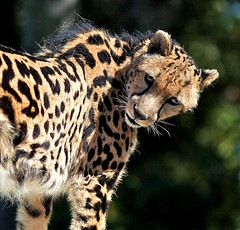
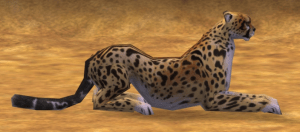
The king cheetah is a very peculiar sub-species of the African cheetah (Acinonyx jubatus). Its pelt pattern is notably different from the more common cheetah’s. The spots, instead of being small and well-spread, are wide, very dark and sometimes even merged into each other (specially so, on the back).

King cheetah

King cheetah

The animal being slightly larger than the more common cheetah, one better understands its title of king cheetah.

As a matter of fact, this is a rare recessive mutation (both parents must have the mutation to transmit it in a visible way to their offspring). This is about the same thing that happens with some leopards (the black panther).

The animal was known only from pelts since 1926 (initally described as Acinonyx rex before being recognized as a variant rather than an independent species), but it was not officially observed until 1974 in Zimbabve and first photographed in 1975 in the Kruger National Park (South Africa). It has been estimated that no more than 60 king cheetahs in the world, and only about 15 living in the wild. Observing it (out of zoos) is highly unlikely out of the Timbavati region of the Kruger park. Even there, you can drive during weeks without any encounter.

Astonishing, isn’t it? But I still prefer the pelt pattern of the more common cheetah; I find it more elegant.

New African agent

(Saturday, December 20th, 2008)

This is not everyday that a new travel agency opens specialized in African wild life and nature (and its big cats). The end of 2008 brings us this event: Creation of Africa Exploration.

The founders went through other African adventures and escapades; This is a good warranty of a fully re-assuring experience and knowledge.

We’ll keep in touch.


Copyright (C) B.Tredez

Copyright (C) B.Tredez

Copyright (C) R.Rey

Copyright (C) R.Rey

The cheetahs’ dinner

(Monday, December 1st, 2008)

These three young cheetah males are actually very powerful, hunt together, take advantage of any kind of possible prey.

In this case, one of them caught an isolated young gnu, just after the rain at the end of the afternoon. What happened seemed quite normal: They need to kill the prey (quite commonly by strangling it) and start eating (young and sensitive minds may not appreciate a quite gory natural scene of such a raw dinner). Since the cheetahs are not very powerful animals (they are fast but slender predators), they keep checking around them because once they are disturbed by other predators (usually hyenas) they leave the scene and do not return.

The two hyenas we see in the third photo did know about this kind of natural rule. They were arriving quite certain that they could easily grab the carcass and eat the kill so easily won. Unfortunately, these three cheetahs are definitely not playing by the book. As soon as the hyenas appear, one of them did not merely leave the kill, but ran to the hyenas and started chasing one of them, kicking it.

This led to a very unusual sight: Three hyenas, totally disoriented, lying low and whining a few feet from the carcass they could see, they could smell, but were not allowed to taste.
(more…)

Cheetahs

(Sunday, November 30th, 2008)

After a month of November where I’ve shown a number of photos about cheetahs, I just wanted to provide a link to the excellent article in Wikipedia about Cheetah (Acinonyx jubatus).

Male cheetah

(Saturday, November 29th, 2008)

A young male, in the end of the afternoon, just before going for a wildebeest dinner.


Cheetah - Copyright (C) 2008 Yves Roumazeilles

Cheetah - Copyright (C) 2008 Yves Roumazeilles

Cheetah - Copyright (C) 2008 Yves Roumazeilles

Cheetah - Copyright (C) 2008 Yves Roumazeilles

Cheetah - Copyright (C) 2008 Yves Roumazeilles

Cheetah - Copyright (C) 2008 Yves Roumazeilles

Click on the thumbnails to enlarge them

Cheetah (Acinonyx jubatus, Guépard, Guepardo), Masai Mara, Kenya, September 2008.

Hope for young cheetahs in Nesles

(Friday, November 28th, 2008)

The Parc des Félins of Nesles (France) as received on the 30th of October, two male cheetahs arriving from the Al-Bustan Zoology Center of Sharjah (United Arab Emirates). The managers of the Parc des Félins hope that these new members of the feline community in Nesles, after their initial acclimatation to the environment of French Seine-et-Marne will allow to obtain births of young cheetahs which have been awaited eagerly for quite some time.

They are named Skop and Taï.


Skop

Skop

Taï

Taï

Source: Parc des Félins.


http://www.ylovebigcats.com/

Copyright (c) 2008-2010 - Yves Roumazeilles (all rights reserved)

Latest update: 30-aug-10

Google.com
YLoveBigCats.com
YLoveBigCats.com