YLoveBigCats.com

Archive for the 'Cheetah' category


Cheetahs are not so fast

(Thursday, August 13th, 2009)

Here is the proof.


YouTube link

Sponsor a cheetah

(Thursday, July 23rd, 2009)

Sponsor a cheetah” is a preservation program targetting those cheetahs that can no longer be released back in the wild because they lived too long in captivity. From the United Kingdom, the Cheetah Conservation Fund, allows to give £100 or more to help the following individual cheetahs:

  1. Blondi, Leia, Josie, Dusty & Sandy
  2. Klein, Merlot, Cruise, Nina, Solo & Kanini
  3. Chanel, Shadow, Toblerone, Hershey & Nestle
  4. Rosy, Samantha, Tempesta & Misty
  5. Cleo, Ohana Luna, Soraya, Quasar & Armani
  6. Kayla, Kiana, Harry, Ron & Hermione

ccf-uk_banner

The running cheetah

(Thursday, July 16th, 2009)

Did you think that the cheetah is actually a thin cat? Slenderness does not equate lack of muscle. Check this video and admire the work of the muscles while this cheetahs run full speed.


YouTube link

At the end of the video, you have also seen a most common event: A cheetah loosing its prey to hyenas quickly arrived at the kill scene to steal the prey.

Hunting is not enough for the cheetah

(Saturday, June 6th, 2009)

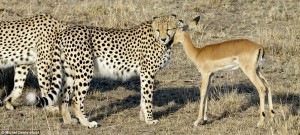
Cheetahs are impressive hunters thanks to their capacity for high speed chases that leave nearly no chance to a surprised victim. But, it is also a very fragile animal which is usually not able to defend its prey. Here is a very common situation: The gazelle he just caught is immediately stolen by the much more powerful hyena that took the opportunity to grab a fresh kill with minimal risk.


YouTube link

Life is unforgiving in Africa savanna.

Save a cheetah

(Thursday, May 21st, 2009)

Sometimes, for endangered species, it becomes necessary to forget re-introduction in the wild, but mere life preservation becomes critical. This is even more important for large carnivores like the cheetah because they need a lot of space and a large quantity of preys asociated to well-developped habits and sophisticated hunting techniques.

Since the cheetahs are also endangered, some of these big cats need to be supported even when they no longer can be freed to the wild world. Here comes the Cheetah Conservation Fund (CCF) that provides protection for injured, old or orphaned cheetahs. About 30 of them.

And you can help them financially, if you are ready to sponsor a cheetah.


YouTube link

When pumas, jaguars and cheetahs lived in Europe

(Monday, April 6th, 2009)

Big cats like lions, pumas, jaguars, cougars, cheetahs or leopards disappeared from continents where they could be found in prehistoric times. Here is a series of articles about prehistoric felines.

Viretailurus

Source: Tretrapod Zoology

Jason Morgan, painter of tigers

(Wednesday, March 11th, 2009)

Jason Morgan paints tigers. He really does.

Siberian tiger (by Jason Morgan)

Siberian tiger (by Jason Morgan)

If you like his work, it’s a time as good as any to go and visit his web site. What is surprising is his willingness to be commissioned to do an original painting from a model you’d select.

But I also suggest you’d go to his blog in order to keep in touch with his work. You will be shown his work during its creation. It’s a great thing to see.

And, not surprisingly, you will notice that Jason Morgan also does cheetahs, lions, leopards and other big cats.

Photos of critically endangered Saharan cheetah

(Friday, February 27th, 2009)

The Saharan cheetah (Acinonyx jubatus hecki) or Northwest African Cheetah is an extremely rare form of cheetah, whose hide is very light with sparse spots, lives mainly in Algeria, Togo, Niger, Mali, Benin and Burkina-Fasso. It is usualyl considered that there is now less between 200 and 300 animals only of this semi-nomadic big cat.

The Office du Parc National de l’Ahaggar (OPNA) organised the photographic trap campaign to try and understand better the habits of this population, its size and its area of dispersal. The result is particularly interesting with a few photo shots from Central Sahara.

The research was undertaken by the Zoological Society of London, Office du Parc National de l’Ahaggar (OPNA) and Université de Béjaïa, with support from WCS and Panthera.

Sources: Zoological Society of London & NewScientist.

King cheetah

(Friday, January 23rd, 2009)

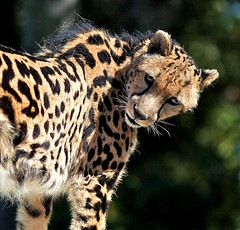
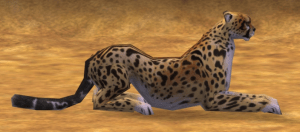
The king cheetah is a very peculiar sub-species of the African cheetah (Acinonyx jubatus). Its pelt pattern is notably different from the more common cheetah’s. The spots, instead of being small and well-spread, are wide, very dark and sometimes even merged into each other (specially so, on the back).

King cheetah

King cheetah

The animal being slightly larger than the more common cheetah, one better understands its title of king cheetah.

As a matter of fact, this is a rare recessive mutation (both parents must have the mutation to transmit it in a visible way to their offspring). This is about the same thing that happens with some leopards (the black panther).

The animal was known only from pelts since 1926 (initally described as Acinonyx rex before being recognized as a variant rather than an independent species), but it was not officially observed until 1974 in Zimbabve and first photographed in 1975 in the Kruger National Park (South Africa). It has been estimated that no more than 60 king cheetahs in the world, and only about 15 living in the wild. Observing it (out of zoos) is highly unlikely out of the Timbavati region of the Kruger park. Even there, you can drive during weeks without any encounter.

Astonishing, isn’t it? But I still prefer the pelt pattern of the more common cheetah; I find it more elegant.

New African agent

(Saturday, December 20th, 2008)

This is not everyday that a new travel agency opens specialized in African wild life and nature (and its big cats). The end of 2008 brings us this event: Creation of Africa Exploration.

The founders went through other African adventures and escapades; This is a good warranty of a fully re-assuring experience and knowledge.

We’ll keep in touch.


Copyright (C) B.Tredez

Copyright (C) B.Tredez

Copyright (C) R.Rey

Copyright (C) R.Rey


http://www.ylovebigcats.com/

Copyright (c) 2008-2010 - Yves Roumazeilles (all rights reserved)

Latest update: 30-aug-10

Google.com
YLoveBigCats.com
YLoveBigCats.com